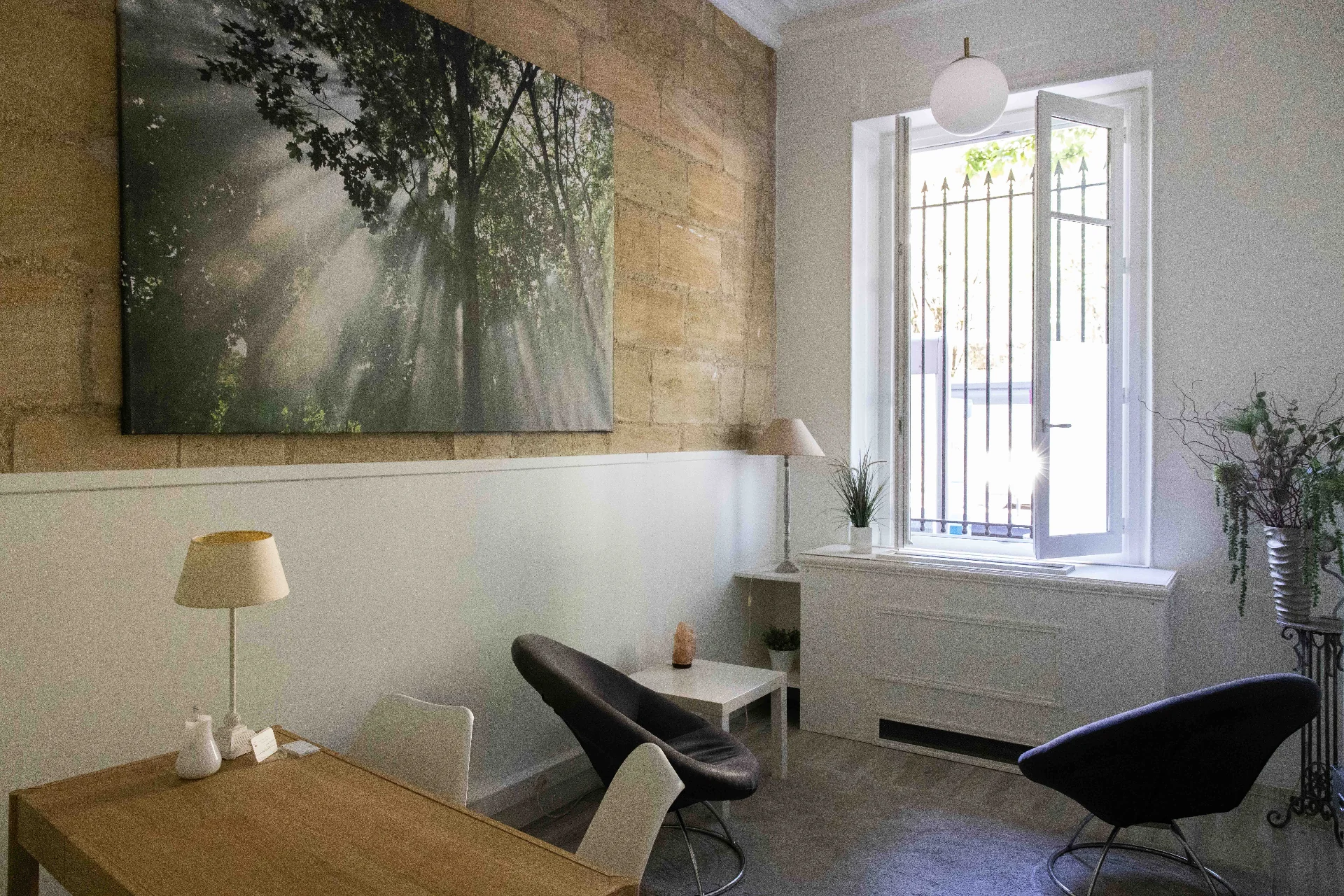
What size do you need for a medical or paramedical office
Choosing the right size for your office is one of the most impactful decisions you'll make. Too large, and you overspend every month. Too small, and you compromise comfort. The answer depends on your profession, whether you work with equipment, and whether you have access to shared common areas.
Realistic minimum areas by practice type
Space needs vary by profession. Realistic minimums, assuming access to shared common areas:
- Psychology, psychotherapy: 11 to 13 sqm
- Dietetics, nutrition: 11 to 14 sqm
- Sophrology, naturopathy: 11 to 14 sqm
- Osteopathy, manual therapy: 14 to 18 sqm
- Speech therapy: 12 to 16 sqm
- Psychomotor therapy: 13 to 16 sqm
- Sexology, counselling: 11 to 13 sqm
These ranges assume access to shared waiting room, facilities and entrance.
The critical role of common areas
A well-designed waiting room, clean facilities and a professional entrance create the first impression for every patient. They directly influence perceived quality.
In a shared space, common areas are maintained collectively, higher quality at lower individual cost. A quality waiting room shared among five practitioners costs €1,000 to 2,000 each.
The oversizing trap
Every extra square metre increases rent, charges and maintenance every month. A practitioner paying €60/sqm/month for 25 sqm when 14 sqm would suffice wastes nearly €8,000 per year.
Start with the right size and expand if and when needed.
What really determines comfort
Comfort depends on layout quality, natural light, acoustic insulation, ventilation and furniture choices, not raw square metres.
Invest in design quality over quantity of space.
Common mistakes to avoid
- Renting too large "just in case" future needs arise
- Ignoring the contribution of shared areas to patient experience
- Confusing total building area with usable private office area
- Underestimating the impact of layout, light and acoustics
- Choosing a space based on raw size rather than functional design
- Paying for a standalone waiting room when shared alternatives exist
Frequently asked questions
Every set-up project depends on your activity, budget and how much you want to share. The simplest step is often to compare your needs with a space that's already designed for care.
Looking for an office in Bordeaux?
Discover I‑CA.RE spaces and let's discuss your project.
The I‑CA.RE approach
I‑CA.RE develops and structures care spaces tailored to care, allied health and wellbeing practitioners. Each space is designed with particular attention to quality, functionality, local integration and economic coherence of use.